


Before I get into things, here’s why I feel entitled to share some lessons:
I grew my own LinkedIn to 43,000 followers, generated over $3m in revenue directly from my profile, interviewed over 100 top founder brands (like Jason Fried, DHH, Adam Robinson) about their approach and playbook, and coached over 30 SaaS founders on how to grow on Linkedin. So I have my own experience plus broad pattern matching.
Now, despite its flaws, if your company sells into senior decision makers (Director, VP and up), LinkedIn is still one of the best and most obvious places to be. And what works on the platform today is a founder-led content model. You know your company, product and customers better than anyone else.
Building your founder brand is one of the highest leverage things you can do (my POV). If done right, it personally makes you millions, helps you attract A-players, gets you exposed to opportunities you would otherwise never have access to, and it becomes a moat for your company that keeps compounding the longer you do it.
But if you’re like most technical founders, you don’t enjoy creating content, you’re super busy, so you need a system on how to approach LinkedIn. Below is what I wish I knew if I was starting from zero again today. I call it the minimum viable knowledge to crush on LinkedIn.
Who this is for
Otherwise the advice won’t fully apply.
You’re a founder / CEO (or you’re helping a founder/CEO do this)
You sell large / high-ACV deals into senior decision makers
You have a clearly defined ICP (ideal customer profile) and they are on LinkedIn. They don’t need to be the most active audience on LinkedIn, but they obviously do need to open the app every now and then
LinkedIn is a means to an end to drive growth and revenue for your company, that’s it. You’re not interested in becoming an influencer. You don’t want to do “whatever it takes” to grow on LinkedIn, you have values and a reputation to protect, and no amount of likes or impressions is worth making a fool of yourself. There are many different reasons you might want to post on LinkedIn and build your founder brand, I’ll focus on when you want to use LinkedIn to drive revenue
Cool. If that’s you, let’s get into things.
This post is sponsored by Thormeier.co

Thormeier.co is my LinkedIn & Founder Brand advisory where I’ve worked with 30+ SaaS and AI founders to build their LinkedIn system.
If you want to understand how I work with founders, book a call here.
What you need to know about LinkedIn
I’m breaking these up into categories. This post already became much longer than I thought it would be, and I could infinitely expand on everything further, but I’m trying to stick to the essentials:
The two parts to Linkedin
There are two parts to LinkedIn and any other social platform: posting and engaging. Posting means publishing your own thoughts. Engaging means replying to comments, replying to DMs, commenting on other people’s posts, sending connection requests, messaging people. Both are equally important and need their own time allocation. If you only want to publish your own thoughts, don’t even bother.
Profile
Do not bother posting on your company page at all. Post through your own personal founder profile, you get roughly 8x more reach given the same amount of followers.
Don’t over-optimize your LinkedIn profile, but make sure an ICP can understand what you do and has a clear path of conversion: decent profile picture, banner image with social proof (eg. customer logos), your tagline should include your job title and what your product company does (eg. CEO at Acme. - RLOps Platform for the Enterprise”), properly connect your LinkedIn company page and make sure the main CTA on the company page is “Visit website”. That’s about it. Ask ChatGPT if you need more granular tips
Audience
If you’re on LinkedIn to drive revenue, your audience is your buyer/ICP. That’s it. Not your peers, not colleagues, not other founders or CEOs (unless that’s who you sell to), not investors, and deeeeefinitely not your friends, even if they have an “opinion” on what you do on LinkedIn. There are other reasons why you might want to build an audience, eg. to recruit employees or find investors. In those cases, your audience is those people, but here we’ll focus on what to do if you want to drive revenue from LinkedIn.
And no, it does not matter if you’re starting out with a low amount of followers or with a network that mostly consists of people that are different to your current buyer/ICP. Once you start speaking specifically to that person in your content, LinkedIn will show your content to those people.
Content
How to write posts that drive revenue (MOST IMPORTANT SECTION)
Regardless of what anyone else tells you, quality matters. The quality of the content you put out, the quality of the comments you leave on other people’s content, the quality of the people you engage with and the messages you send. You know your customers best. When you say something, make sure it’s something useful and relevant to them. Just because a meme or a controversial clickbaity statement gets more engagement, does not mean that it pays positively into the trust bank of the people who matter most, your customers and prospects.
There’s only one type of content you need to master. I call these direct response posts. Take your ICP/buyer, make a list of all of their goals and problems, highlight the subset of them where your product/solution/service helps, and then write a piece of content about that goal or problem and provide a solution to it. A solution can take the form of an insight or aha moment or mindset shift, a story of someone else who you know who had that same problem and how they went about solving it, a framework or playbook or step-by-step tutorial, or pointing them towards a larger resource like a book or a podcast they should consume. That’s it. You don’t need to talk about anything personal. You don’t need to learn how to do selfies. You don’t need to figure out how to design a carousel. If you do this over and over and over again, you’ll do well. Important here: Do not, ever, shy away from mentioning your company or product in the places where it makes sense to mention it, either because it makes that solution easier, faster, better, cheaper to accomplish, more streamlined, or more complete. The goal is actually to write as many posts as possible where you can naturally mention and link to your company/website.
Example #1:
Let’s say you sell to enterprise CTOs
Let’s say their high-level goals, priorities, and problems for this year and quarter are generating measurable ROI from AI tooling, improving product security and reliability, reducing AI token spend, modernizing legacy systems, and bringing products to market faster.
Let’s say you sell an AI coding tool
Therefore, out of all of the goals and problems those CTOs have, your product impacts most directly the first and last priority, and indirectly impacts at least two others
For your post, pick one of them and help them make some small or big progress on this, either by sharing a framework or strategy on how you’d approach this, pattern-matching across what you’ve seen across your customer base of how people have handled this successfully, any resource you would point them to, a mindset shifts that reframes that problem in a way that you believe is more productive, or by sharing a story that relates to that problem or goal, either from yourself or someone you know (can be anonymized) that might provide some insight.
Example #2:
Let’s say you’re Gong
Let’s say you sell into VPs of RevOps
VPs of RevOps have a mandate to improve revenue predictability. One of your product’s features is forecasting, which helps towards this goal
Start with that pain point/goal in the hook, eg. (I’m winging this) “A lot of RevOps leaders are pressured to improve revenue predictability, here are the top 3 data points to track that I’ve found have the highest correlation with closed-won revenue (and how to track them):”
NOW you provide actual value. A solution, a tip, a framework, a strategy, a mindset shift, a detailed diagnosis, etc. etc. - you’re not allowed to jump immediately to “BUY OUR PRODUCT”
So in this case, list the actual 3 data points, where to find them, and how to extract them (manually, using Claude etc)
Your goal is, that at the end of the post, there is a NATURAL opportunity for you to tie it all back to your product, something like “You can home-grow this, but we built XYZ (your product/feature) to allow RevOps leaders to track exactly this natively inside of Salesforce. One click and you have this data right in your CRM”
What that can look like:
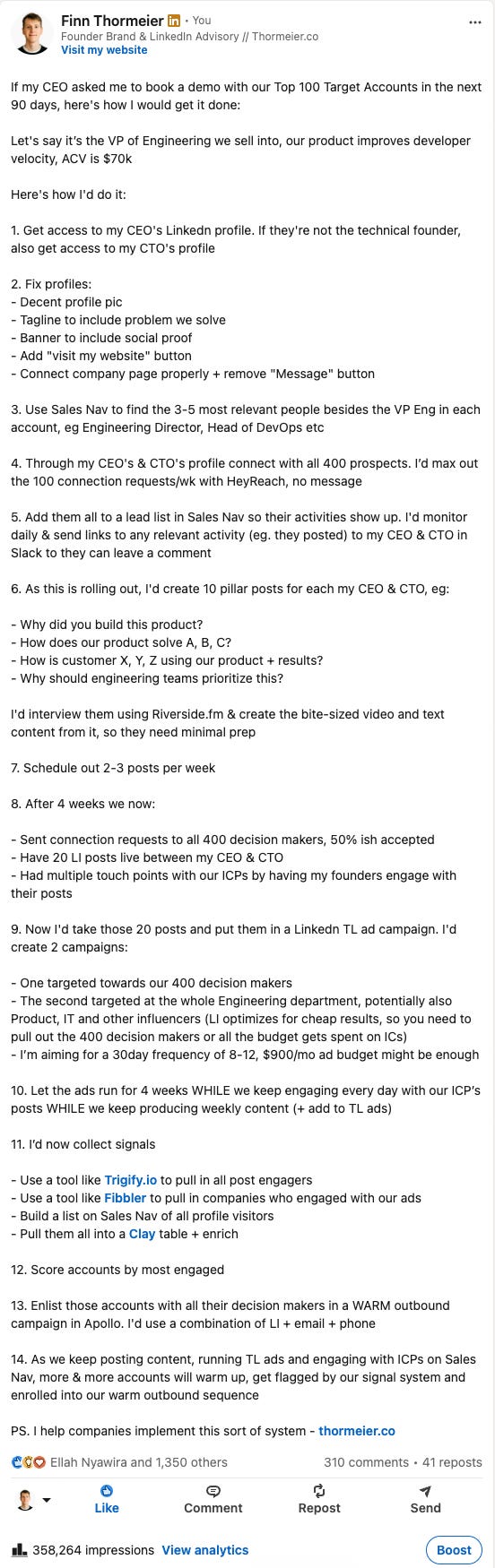
Btw, that post above generated somewhere between 25-30 inbound sales calls for me. I think it would’ve done a lot better, but I made the mistake of only including the PS much later. Check out Gal Aga, founder/CEO of Aligned, he nails this style of post.
The only other type of content I believe you should share is big milestones for your company. Don’t force it into some sort of weekly post, you’ll naturally know when you have a big milestone, because you will almost not be able to NOT talk about it. A big funding round, a new feature/product/use case, a big new customer you’re allowed to disclose, a revenue milestone, a new office you’re opening in a new location, etc. Share that news factually, why you’re excited about it, what it means for the future of your company, and what it means to your customers. Then move on and return to talking about customer problems.
Beyond those two types of content, and especially the first one, there’s no other kind of content you need to share if the goal is driving revenue. If you feel like it and you have fun doing it, you can definitely talk about your journey, build in public, share personal stories and experiences, post selfies, but just know that those are recreational things, not value drivers, at least not directly. There are other benefits to those posts, they help build your community or peer relationships, but generally, my POV is that people waaaay overindex on this, partly because it’s the easiest type of content to get likes on (and dopamine addiction is a real thing).
I strongly believe that the best-case scenario is that it’s the founder writing their content themselves. Almost any founder with a big following or brand, that you know of, is probably heavily involved in the actual creation of the content you see. I would always start with this, and only if it really doesn’t work, I would try getting someone on my team to help me write or draft content, working with Claude to help draft content, or hiring an external ghostwriter or agency. All of these options are second or third-best options. You know your company, product, and customers better than anyone else. That’s why it should be you. Writing is thinking, so in the process of writing your content, you come up with better insight. And having a unique or weird writing style (like all lower caps or using swear words liberally) is actually a massive competitive advantage these days because clean, polished writing is now infinitely available through Claude and ChatGPT.
Post format & length
Every content format works on LinkedIn: Videos work, text-only posts work, images work, carousels, infographics, anything. I promise you. For every single content format, I’ve had someone on my podcast who only does that format, and they found success with it. What matters is that you find the one that’s most suitable to you and and comes most naturally to you. For most people, that means focusing on text-only, and attaching an image every now and then when there is one that’s relevant to the thing you talk about. Not some AI-generated thing, not a random stock photo. If you talk about meeting a customer and you happen to have a photo of you meeting that customer, use it. If you talk about doing a team offsite and you have a picture of that, use it. If you talk about an experience you went through and you have a picture of you going through that experience, use it. Otherwise, don’t.
The character limit for a LinkedIn post is 3,000 characters. That’s about 500 words or one regular Google Doc page, assuming some line breaks and paragraphs. That’s the max, but it can be as short as a sentence or two. There’s no correlation between post length and performance (with performance, I always mean revenue/pipeline/leads, not likes). There’s only a correlation between a posts’ usefulness to the prospect and performance. Sometimes it’s more useful to have a short post if you can get a point across with fewer words. Sometimes it’s more useful to have a long post because you need to include details, nuance, or a specific example to make it useful. Some of my best posts in terms of call bookings were maxed out at 3k characters.
Posting time & scheduling
Posting time doesn’t matter. Just post when your prospects are awake and you’re around to answer some of the initial comments and messages, but generally I prefer mornings, so the first half of the day.
Anecdotally, Renee Shaw, who regularly goes viral on Linkedin with comedy content, told me that she schedules most of her posts for 4am her time while she sleeps because she’s based in Australia, and she sees no correlation. Sometimes the posts don’t do well, and sometimes she wakes up hours later to thousands of engagements.
Also, scheduling your post doesn’t really seem to affect reach, even though there’s this running myth that it does. My personal point of view is that it’s correlation, not causation. If you schedule a post, it’s more likely that you end up not being around or answering any of the comments and messages that it generates, and that definitely has an impact on reach
Including links
You can absolutely include links, but only include the link when including it is more useful to the reader, eg. if it links to a resource you mention that people would genuinely be interested in looking at. If you only include the link because you selfishly hope to drive people to some destination that doesn’t have any added value to them, don’t include it. Some of my best posts have included links.
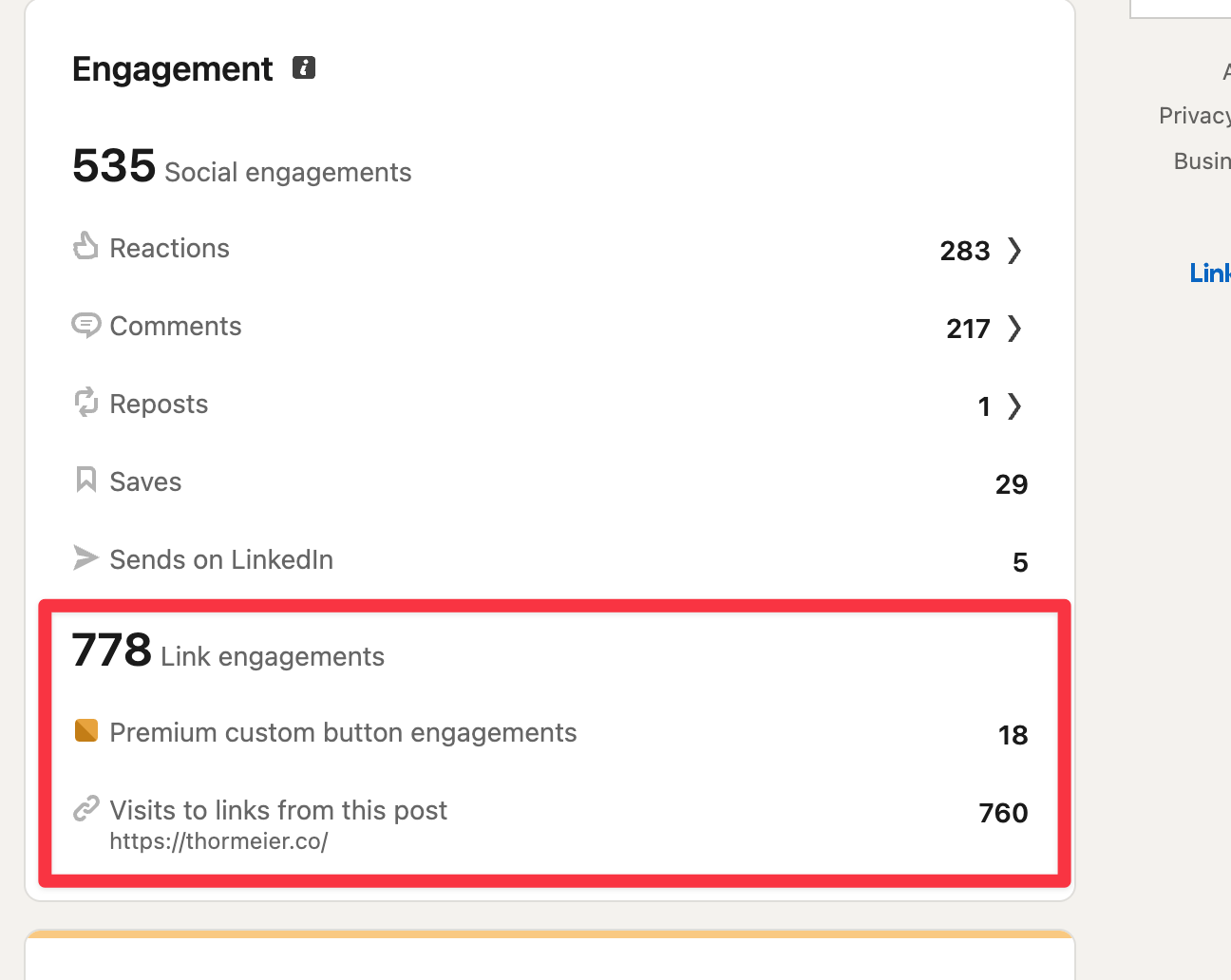
This recent post of mine drove 778 clicks to my website on 26k impressions
Engaging
Almost anyone who’s successful on LinkedIn, unfortunately, spends a ton of time on the platform. It really matters, I can’t emphasize that enough. If all you do is spend time writing great content and then you piss off, I guarantee you, you won’t drive revenue from LinkedIn.
I think the right way to think about LinkedIn is as a 24/7 networking event. The way you get value from a networking event is to be social. Go somewhere where your prospects and customers are, and then shake hands, talk to people, ask them questions, be curious, be helpful, share your own insights and POV, schedule follow-up meetings, ask for intros, give intros. If you treat LinkedIn like that, you’ll be successful.
Daily and weekly routine
If I had to “prescribe” a LinkedIn routine, here’s what I’d start with, based on everything I’ve learned working with over 30 founders:
Posting Routine
Post 3 times per week. That’s enough to build meaningful momentum, and you can always do more later on.
Allocate 1 hour per post. That’s 3 hours total to write those three posts. Time block them on your calendar. Some people do best with one large block every week, others do better with three individual 1h blocks. A lot of founders and CEOs I know have this large time block either on the weekend or in the evening when there’s no day-to-day Slack distraction, etc. The 1h are a starting point. You might realize that you only need 20-30 minutes to write a post, or maybe you need an 2 hours, but I would always lean towards more time to write a proper, thorough, thoughtful post than allocate too little time and end up writing garbage. Quality writing takes time. And when I say 1 hour to write a post, that’s hands on keyboard, typing, editing, maybe some research.
I believe 80% of your posts should focus on the problem/solution-type content we discussed. The remaining 20% can be for those big announcements, milestones, or anything else random you feel like sharing. That’s an unpopular POV. Most people will tell you to split your content more evenly between problem-solution content, founder story/journey, personal content, and company updates. If you personally like that kind of stuff, go for it. But again, we’re focused here on building a hyper-efficient strategy if the goal is not to get likes or props from your founder friends, but to drive revenue.
I would heavily, heavily refrain from using Claude or ChatGPT for this, especially in the beginning. The hard part about the writing is not having some special writing skills, but to actually think through one of those customer problems and coming up with something cohesive. If you outsource that thinking part to the LLM, it’s a race to the bottom. You’ll end up with a generic insight that’s written in a generic voice. Plus, people are more and more allergic to AI tells. Building a LinkedIn copywriting agent that actually sounds like you, that forces you to properly think through an insight or POV, and that doesn’t produce slop is its own hard engineering problem, and you can waste hours and hours trying to build something before even understanding what your voice is or what your audience cares about.
Engaging routine
Beyond the writing block, block off 30 minutes every day to go through the following checklist on LinkedIn, ideally right before or right after posting:
Check all your notifications
Reply to all your comments (unless they are clearly AI-generated)
Answer all your messages/DMs (unless they’re a pitch/ or completely irrelevant)
Check all new connection requests, accept relevant ones, and send them a short note asking why they connected. I usually say something like “hey NAME, appreciate the connection request, how come? Saw that you…. “ (something that stood out to me when I checked out their profile: a company they worked at that I know, a shared connection, an interesting hobby or interest they mention, etc)
Write at least 5 comments on other people’s posts, if you’re really committed to 10. Prioritize posts by your prospects/customers, and prioritize meaningful, thoughtful comments
Now 4 things that almost no one does that drive a disproportionate amount of revenue:
Send 3 DMs every day. Not new connection requests, but to your exisiting connections/network. Current customer, old customers, previous collegues, partners, anyone you want to stay in touch with. Come up with a meaningful things to say to them. Could be Congratulating them on a recent life or work event, asking how they’re doing, sharing something with them that you feel like they might find interesting or useful, anything. Sounds like nothing, but I promise you, if you do this every single day, that’s almost 100 people that you stay in touch with, reconnect with, or catch up with every single month. That shit adds up. Don’t forget, for better or for worse, LinkedIn is still a SOCIAL network
Check who visited your profile, and if they’re relevant and you’re not yet connected to them, send them a connection request with a conversation starter. And when I say conversation starter, I mean not a pitch, but a question, similar to the one above, adjusted to your voice: hey NAME, saw that you…. [Question about that]“ (something that stood out to me when I checked out their profile: a company they worked at that I know, a shared connection, an interesting hobby or interest they mention, etc). You can find them here: https://www.linkedin.com/analytics/profile-views/
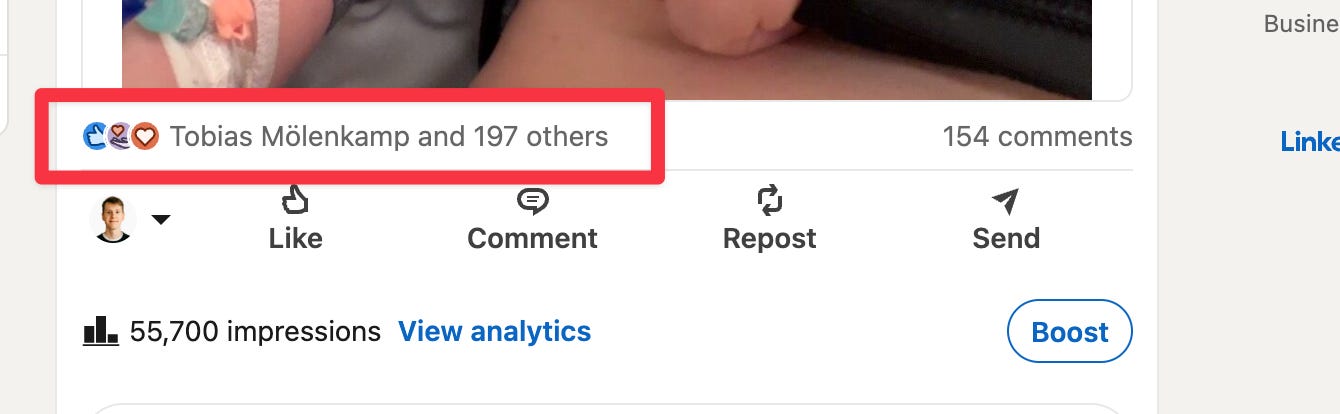
Check post engagers: Go to your most recent post, look at every single person who engaged with that post (liked or commented), and same thing there. If they’re a relevant person and you’re not yet connected to them, send them a connect request with a conversation starter
Check new followers: Same thing here. Go through every new person who started following you, and if you’re not connected to them and they’re relevant, send them a connection request with a conversation starter: “hey NAME, appreciate the follow, what do I owe this to?” You can find them here: https://www.linkedin.com/mynetwork/network-manager/people-follow/followers/
If you’re as anal about this as me, you can use this basic tracker to keep yourself accountable:

Now you got your routine: a 30min block once a day with a clear set of actions to perform during that time, and one 3h block once a week to write 3 posts. If you do the math, it’s about 5-6 hours per week, which should be roughly 10% of your workweek. If that sounds like too much, don’t bother.
If this was helpful, and you’re a SaaS founder/CEO who needs help figuring out how to grow on LinkedIn or drive more revenue from it, book a call here: Thormeier.co